Most applications need exactly one dependency: spiffe-spring-boot-starter.
The other modules exist so that each concern stays small and optional.
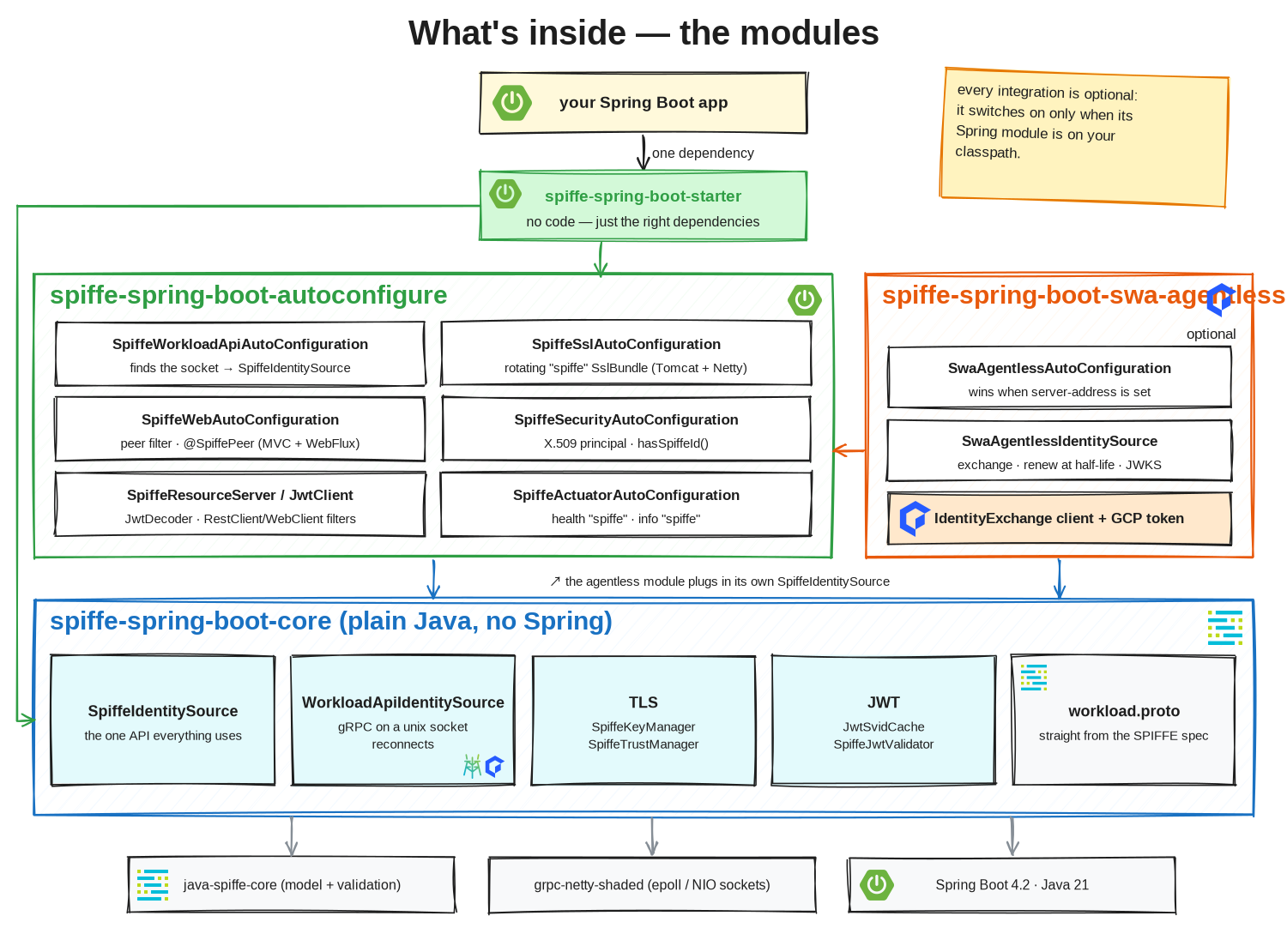
| Artifact | Purpose |
|---|---|
|
The dependency an application adds. It brings in the auto-configuration and the core. |
|
All the auto-configuration. Every integration (servlet, WebFlux, Spring Security, HTTP clients, Actuator) is optional and only activates when its classes are on the classpath. |
|
Spring-free code: a Workload API client built on |
|
Optional. An identity source for IDIRA SWA with no node agent. |
|
A bill of materials that keeps every module on one version. |
Using the BOM
Import the BOM when you use more than one module, and leave the versions out of the individual dependencies:
<dependencyManagement>
    <dependencies>
        <dependency>
            <groupId>org.spiffe-spring-boot</groupId>
            <artifactId>spiffe-spring-boot-bom</artifactId>
            <version>0.1.0-SNAPSHOT</version>
            <type>pom</type>
            <scope>import</scope>
        </dependency>
    </dependencies>
</dependencyManagement>

<dependencies>
    <dependency>
        <groupId>org.spiffe-spring-boot</groupId>
        <artifactId>spiffe-spring-boot-starter</artifactId>
    </dependency>
    <dependency>
        <groupId>org.spiffe-spring-boot</groupId>
        <artifactId>spiffe-spring-boot-swa-agentless</artifactId>
    </dependency>
</dependencies>dependencies {
implementation(platform("org.spiffe-spring-boot:spiffe-spring-boot-bom:0.1.0-SNAPSHOT"))
implementation("org.spiffe-spring-boot:spiffe-spring-boot-starter")
implementation("org.spiffe-spring-boot:spiffe-spring-boot-swa-agentless")
}
The BOM is published without a parent, so importing it never pulls in Spring Boot’s dependency management or anyone else’s.
Dependencies worth knowing
-
gRPC with shaded Netty. The Workload API client uses
grpc-netty-shaded, which ships epoll for Linux and falls back to NIO unix sockets elsewhere. It needs no extra native jars and never clashes with Reactor Netty. -
gRPC and protobuf versions come from Spring Boot. The starter is built and tested against the versions Spring Boot 4.2.0 manages, which are the ones your application resolves.
-
java-spiffe-core for the model only. The starter uses its SPIFFE ID, SVID and bundle types and validators. The Workload API protocol itself is generated from the SPIFFE specification’s
workload.proto, so the platform-specific transport artifacts of java-spiffe are never needed.
Java modules
Every jar declares an Automatic-Module-Name, so it can be used from a modular application:
| Artifact | Module name |
|---|---|
|
|
|
|
|
|
|
|